One press. Two proven worlds. New hybrid approach.

Why Gallus is relying on B&R technology for their new hybrid printing press

Flexibility and responsiveness have always been key drivers for the printing industry. Customer requirements continue to evolve, while production run lengths are becoming shorter due to just-in-time production models, faster turnaround expectations, and increasing complexity. At the same time, cost and profitability have become even more critical. As a result, total cost of ownership has moved to the center of investment decisions, making efficiency and equipment utilization more important than ever.

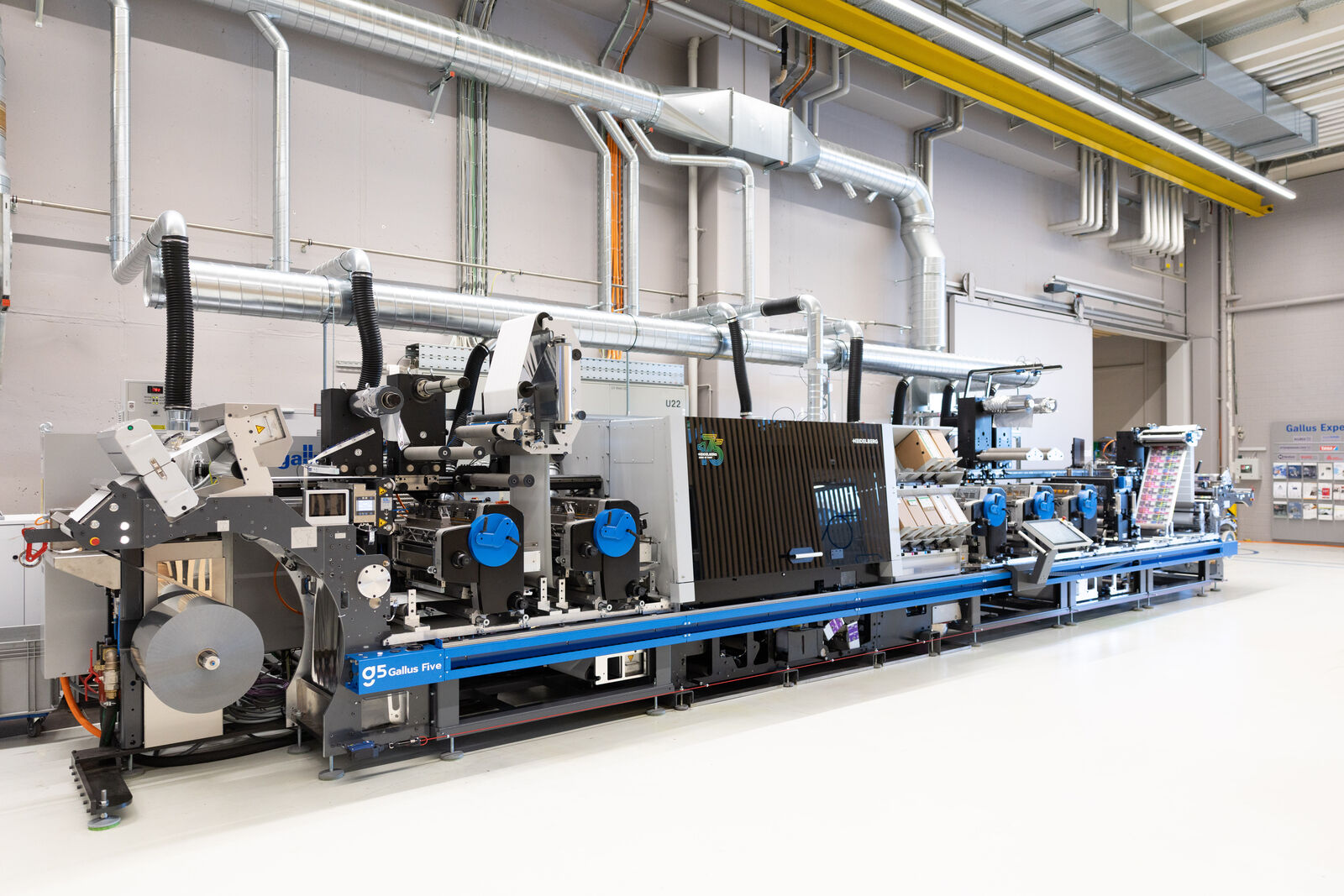
When developing the “Gallus Five”, these challenges were key for Gallus Group, a global leader in the development, production, and distribution of presses for the label and packaging industry. The new machine combines flexographic printing with digital inkjet – leveraging the unique strengths of each technology. Flexographic printing handles the static elements of the print image, where it excels in cost-efficient ink usage, outstanding area coverage, and the application of spot colors. Digital printing takes over the variable components while delivering exceptional detail reproduction. B&R technology forms the automation backbone of the new hybrid press – underlining the adaptive approach that is needed to respond to the challenges, the printing industry is facing.

The concept: Combining two proven worlds

With the Gallus Five, Gallus deliberately chose an evolutionary rather than a disruptive approach. Instead of developing an entirely new platform, the company combined two technologies that had already proven themselves in the market. The new press brings together the digital flexibility of the Gallus One with the mechanical robustness and modular architecture of the Gallus Labelmaster. At the heart of the Gallus Five is the new, highly pigmented Heidelberg Saphira UV05 ink set that was developed in-house by HEIDELBERG and Gallus. It is fully LED-curable and enables production speeds of 100 m/min, a key feature that sets it apart from the Gallus One.

The concept of Gallus’ hybrid presses involves replacing multiple conventional print units by a single high-performance digital print engine. This significantly reduces setup effort and enables economical production even for shorter and more variable job runs. At the same time, the machine retains the modular structure and process stability required for industrial production environments.

The Gallus Five is fully embedded in Gallus’ System to Compose – a modular building block concept that allows printing, converting and finishing technologies to be combined on a single platform. This makes it possible to configure the machine precisely to current requirements while keeping the option to adapt or expand it later as markets, applications or production strategies change.

The challenge: Adapting to an industry in transition

The development of the Gallus Five was driven by fundamental changes in the label and packaging market. Customer requirements are becoming more dynamic, production run lengths are shrinking, and the number of SKUs continues to grow. At the same time, operators are under increasing pressure to deliver quickly, reliably and cost-efficiently.

“In this environment, total cost of ownership has become a key factor in investment decisions. Equipment utilization, changeover time and waste reduction are now just as critical as print quality and speed”, explains Dario Urbinati, CEO of Gallus Group.

Fully committing to either purely digital or purely conventional production models can limit the ability to respond to changing demand.

“The Gallus Five was conceived as a response to this challenge. By combining high digital flexibility with industrial-level productivity, the machine allows operators to adapt their production strategies without sacrificing efficiency or profitability. It offers end customers a way to stay responsive in a volatile market while maintaining the performance levels required for volume-driven applications”, he added. With speeds of up to 100 m/min for hybrid printing, the press shifts the economic breakeven point for digital-hybrid production up to around 10,000 running meters, making it viable for volume-driven markets. Together, these elements allow to adapt production strategies as demand changes, without sacrificing efficiency, process stability or profitability.

The guiding principle: Adaptability in design

From the outset, the Gallus Five was designed around one central requirement: a consistently stable product flow through the machine.

“In label printing, quality and productivity depend on precise synchronization between material transport and motion control, especially at high speeds”, explains Ronny Guber, Global Industry Segment Manager Printing at B&R.

To achieve this, Gallus relies on a tightly integrated automation architecture that ensures exact coordination of all axes relative to the web. Modular machine design and flexible option handling were therefore not added later but defined as core principles of the system architecture. B&R technology forms the automation backbone of this approach. The Gallus Five uses a compact yet powerful control setup based on X20 controllers, ACOPOSmulti servo drives, integrated safety technology and a customized HMI and industrial PC concept. The distributed print unit control cabinets are interconnected via the POWERLINK real-time network and the 750VDCbus of the multi-axis servo system, supporting a modular machine layout while minimizing wiring complexity. This automation framework allows Gallus to make optimal use of hardware resources while maintaining scalability, enabling machine configurations to be adapted, extended or upgraded even after commissioning.

The transition: From technical concept to operational impact

For end customers, the technical concept of the Gallus Five, supported by B&R technology, translates into actual operational advantages. The combination of high-speed digital printing and automation flexibility significantly reduces setup times and simplifies changeovers, making shorter as well as longer runs economically viable without compromising productivity. At the same time, the high level of process automation supports stable, repeatable production at industrial speeds, reducing waste and increasing overall equipment effectiveness.

Additional efficiency gains result from energy savings and reduced consumables. The fully LED-curable ink system lowers power consumption for curing by around 50%, while higher ink pigmentation reduces ink usage. Together with the reduction of printing plates and the associated setup waste, this contributes to lower operating costs and improved sustainability. Beyond these measurable effects, the modular architecture of the Gallus Five gives full flexibility to respond to new applications and market requirements with minimal disruption to existing production.

The future: A platform built to evolve with the industry

With the Gallus Five, Gallus has not only introduced a new press but reinforced a long-term platform strategy. Built on a consistent automation framework and fully aligned with the System to Compose, the solution is designed to evolve as production requirements change. Gallus has relied on B&R technology across its entire portfolio since 2009, and this foundation continues to support future developments — from software upgrades to the integration of additional technologies.

For operators, this means investing in a machine that is not defined by a single production model, but by its ability to adapt. In an industry shaped by constant change, the Gallus Five provides a stable, scalable basis for both current demands and future opportunities. This long-term viability is underpinned by B&R’s broad and consistent automation portfolio. With modular hardware, a unified software architecture, and open interfaces, B&R provides the flexibility required to continuously adapt machine platforms over time. New functions or technologies can be integrated step by step, without disrupting existing systems — making B&R a strong technology partner for manufacturers like Gallus that design their machines with both current needs and future developments in mind.

Dario Urbinati

CEO Gallus Group


“In this environment, total cost of ownership has become a key factor in investment decisions. Equipment utilization, changeover time and waste reduction are now just as critical as print quality and speed.”

Ronny Guber

Global Industry Segment Manager Printing at B&R.


“In label printing, quality and productivity depend on precise synchronization between material transport and motion control, especially at high speeds.”

Si prega di scegliere il Paese e la lingua

B&R Logo