From offset to inkjet: printing on coated paper in industrial production

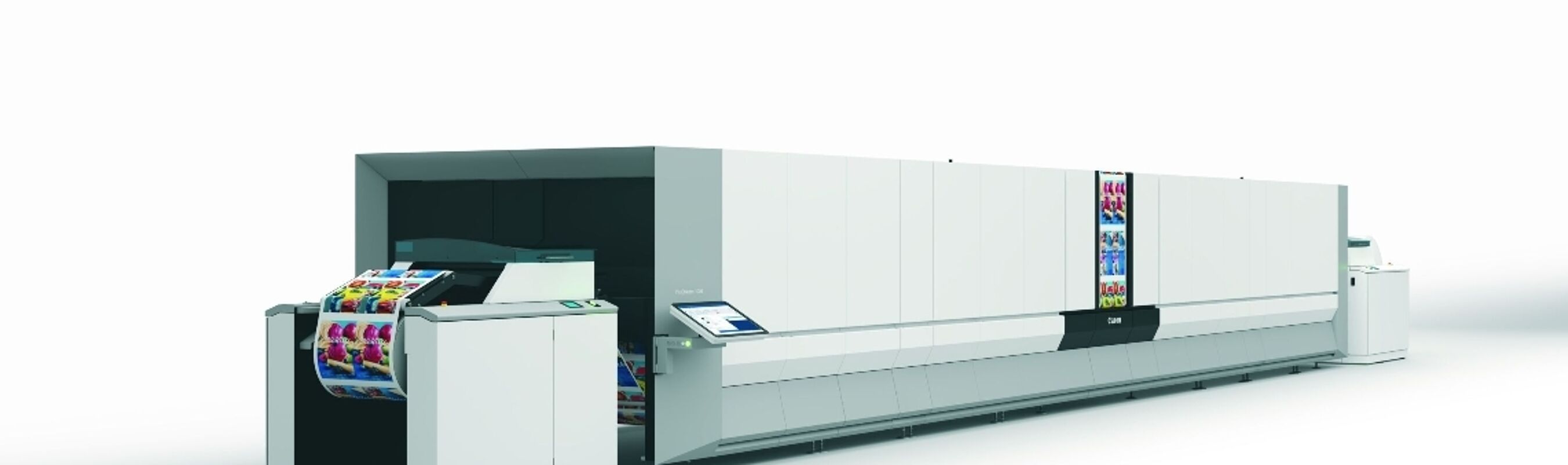
What was previously reserved for offset printing has, for some time now, also been achievable with Canon Production Printing’s inkjet systems. The Canon ProStream, now in its second generation, enables print service providers to produce high-quality print products more flexibly and cost-efficiently than with conventional web offset presses. A key contributor to this development is the use of dynamic drive systems and high-speed web handling technology from B&R, ABB’s Machine Automation Division.

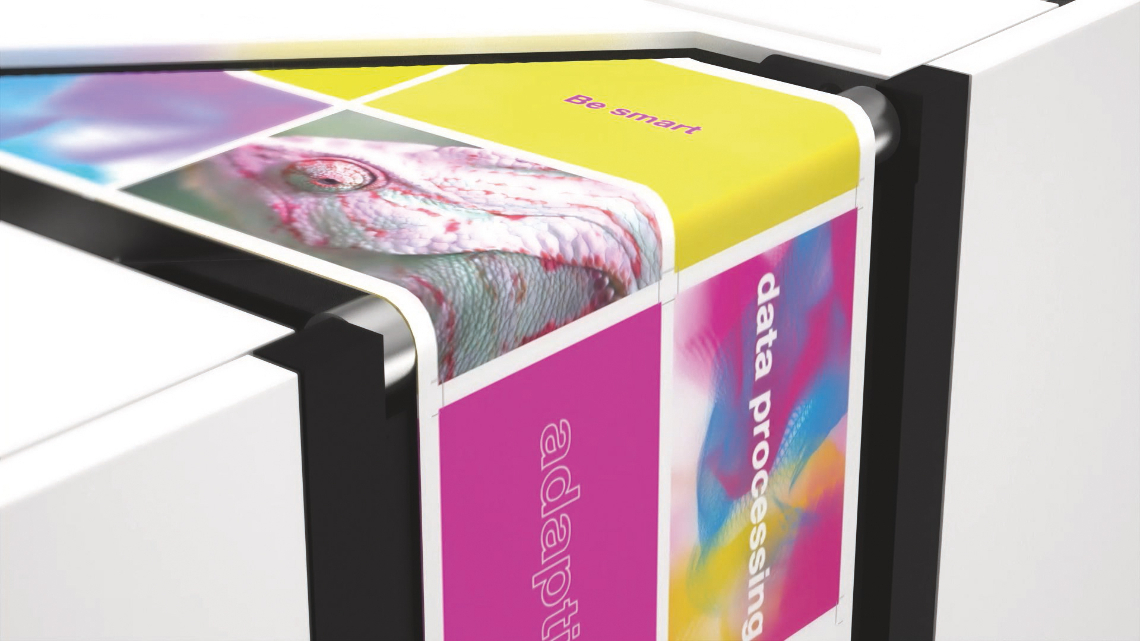
High-gloss magazines, art prints and advertising brochures are typically produced on coated paper to achieve the desired visual and tactile quality. This paper is usually treated with a coating of pigments and binders and then smoothed using rollers.

Coated paper allows for particularly sharp and vibrant print results. Until recently, however, this was limited to offset printing, as the material was optimized for that process. Conventional inkjet printers are generally unsuitable for coated substrates: the ink pigments do not sufficiently adhere to the smooth surface, causing the image to blur. As a result, inkjet systems were largely confined to applications with lower quality requirements, using uncoated papers, while offset printing remained the only option for high-end production with adequate productivity and cost efficiency.

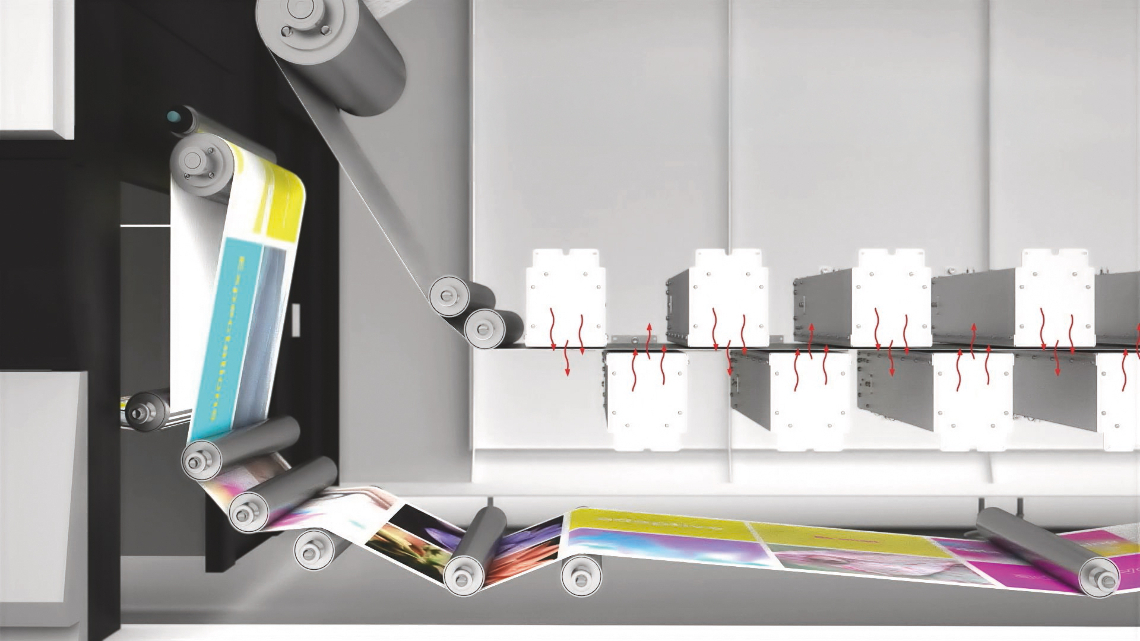
This changed in 2017 with the introduction of the Canon ProStream. Its polymer-based ink technology, combined with optimized, non-contact air drying, enables - for the first time - an inkjet web press to print on a wide range of glossy, silk and matte coated papers. Both print quality and productivity match or exceed those of offset printing. In the second generation, the ProStream 3000, further improvements to ink, drying and cooling have increased productivity by 20% at the same energy consumption.

Inkjet technology also offers a fundamental advantage over offset printing: as a fully digital process, it allows for complete variability of printed content without the need for makeready procedures when changing jobs. This makes even very short runs economically viable and enables new business models. Print service providers can increase flexibility and explore applications such as print-on-demand and highly personalized products, which offer greater communication value.

The Japanese printing technology specialist Canon, with its R&D and production site in Poing near Munich, has addressed this challengeone that is likely to benefit the industry as a whole.
Comparable print quality and throughput

Canon set out to develop a digital printing system capable of delivering print quality and productivity comparable to offset technology. The result was the ProStream, launched in 2017. This ground-up designed inkjet web press can process a wide range of substrates, including coated papers. It meets the quality requirements defined by the “Process Standard Offset” while achieving an effective monthly output of up to 50 million A4 pages. At the same time, it enables variable data printing, making it possible to produce short runs and personalized products as cost-effectively as large-scale industrial jobs.

Meeting these requirements called for advanced engineering solutions. In addition to the new polymer ink technology and the associated non-contact drying system, the ProStream incorporates state-of-the-art printheads and a high-performance web handling system.

For the first time within Canon’s portfolio, the web handling system is based on hardware from B&R. It controls six servo drives that power the rollers transporting the paper through the machine and maintaining precise web tension. This is particularly critical for coated paper, where the smooth surface makes tension control significantly more demanding than with uncoated substrates.

B&R as Canon’s drive technology partner

“We defined a comprehensive set of requirements for the drive system before the project started and thoroughly evaluated the shortlisted candidates,” explains Steffen Pfeuffer, International Product Manager at Canon Production Printing in Poing. “The outcome clearly showed that B&R Industrial Automation was the right technology partner for us.”

Together with B&R experts, Canon selected ACOPOSmulti servo drives and a control system from the X20 series, complemented by B&R servo motors. This solution enabled the engineering team to implement precise and responsive web tension control with excellent synchronization accuracy - forming the basis for the ProStream’s high print quality.

For the implementation of web tension control, the developers used a standard PI controller function from the B&R portfolio. “Following extensive discussions with B&R experts on different implementation approaches, we opted for the PLCopen version as it offers the greatest flexibility in controller design,” recalls Johann Bartosch, responsible for control software development at Canon Production Printing.

The openness of B&R’s technology aligns very well with our engineering approach and supports our collaboration

Full control for the user

“The openness of B&R’s technology aligns very well with our engineering approach and supports our collaboration,” Pfeuffer adds. “B&R showed us different ways to achieve our objectives and helped us build the necessary expertise, enabling us to fully control and further develop the chosen solution independently.”

This allowed Canon, for example, to seamlessly integrate drive-related alarms into the printer’s overall alarm management system. The high level of integration within B&R systems also reduced engineering effort and allowed the team to focus on core functions. “Values from the safety controller and safe I/O are automatically available in the standard control environment,” Bartosch explains. “With other suppliers, we have experienced more fragmented software architectures, resulting in additional effort.”

Reduced risk and cost for machine builders

The use of B&R’s integrated safety technology also facilitated compliance with the Machinery Directive, which applies to web-fed printing presses such as the ProStream. “The fact that we use B&R safety technology positively influenced the inspection process from the very beginning,” says Bartosch. “The inspector from the professional association was confident that the conformity assessment would proceed smoothly - and that proved to be the case.”

Canon uses the integrated safety system, among other things, to ensure that potentially flammable vapors, which can arise during drying, remain at safe levels. The required fans are driven by asynchronous motors controlled via ACOPOSmulti drives operating in inverter mode, eliminating the need for separate inverter units. This reduces the number of component types and simplifies spare parts management and procurement. As a result, overall system costs for the ProStream are lower, despite the higher initial investment in servo drives.

In addition, B&R’s global presence and cooperative approach to parts supply provide strong support for Canon’s development teams and production facilities. “This is particularly important for us, as the ProStream addresses a large portion of the print market, and demand has been consistently high since its launch,” Pfeuffer concludes.

Si prega di scegliere il Paese e la lingua

B&R Logo