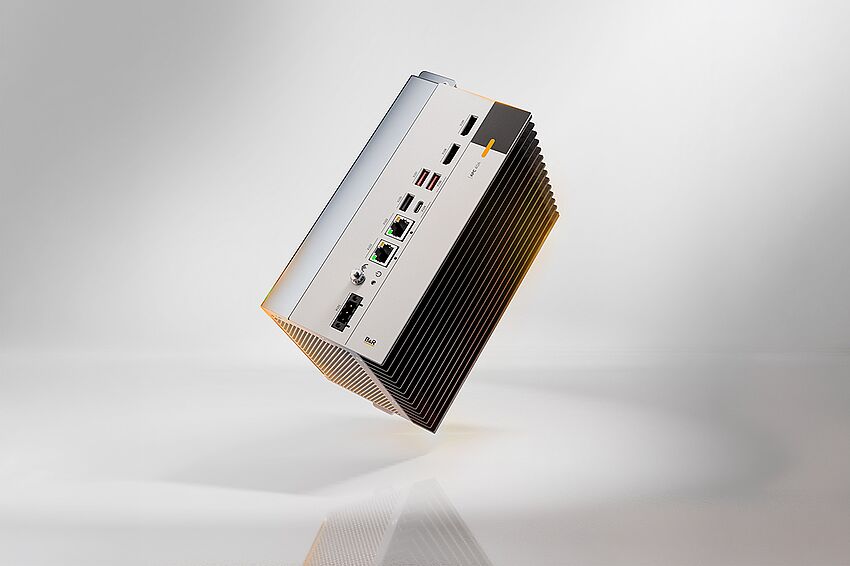
Automation PC 40A: Performance, AI and Scalability
Performance That Pays Off
With high computing power, integrated AI capabilities and flexible scalability, the Automation PC 40A brings high-end functionality to new market segments
Beyond their classic tasks, industrial PCs are increasingly taking on the analysis and preparation of process information. They handle image data, efficiently run complex algorithms, and are increasingly becoming the central computing platform of modern machines. At the same time, machine builders are facing growing competitive pressure. Stephan Hatheuer, Global Product Manager Industrial PCs and Panels at B&R, explains why the right balance of performance, cost-effectiveness and future-proofing matters more today than simply maximum computing power.
Industrial PCs keep getting more powerful. Does more performance automatically mean more value for the customer?
Not necessarily. Today, it’s less about always offering what’s technically possible, and more about providing exactly the performance a customer needs for their environment and use case. Cost-effectiveness and efficiency matter more than ever. Some applications require maximum computing power for complex visualizations or large AI models. Others primarily need an efficient platform with enough headroom for future feature additions and upgrades. That is why the scalability of our portfolio plays such a decisive role: customers should be able to choose exactly the platform that meets their needs. At the same time, we give them every opportunity to scale as requirements increase.
Was that the starting point for the Automation PC 40A?
Exactly. We saw a gap between our classic B&R PCs and the requirements of some customers, which called for additional variants. That is why we expanded our portfolio with the Automation PC 40A. It combines high computing performance, integrated AI capabilities and passive cooling in a very attractive price-performance ratio, designed for reliable 24/7 operation in industrial environments. On top of that, innovation cycles keep getting shorter. That is why our goal is to make new technologies available faster while still ensuring long product lifecycles and maximum availability. To continue offering our customers the best possible solution for their respective applications, we are working hard to continuously expand our portfolio and turn concrete ideas into reality. So, there is plenty more to come.
The Automation PC 40A is using AMD processors for the first time in around 20 years. What are the reasons behind this decision?
An important aspect was supply chain security. With a second processor platform, we become more independent and create greater stability in the supply chain, both for us and for our customers. The current AMD generation also offers exactly the characteristics we were looking for. The processors deliver strong graphics performance and integrate a Neural Processing Unit for the first time. This allows many AI applications to run directly on the device, without additional internal or external hardware and without the need for a complex and security-critical cloud. This gives us a powerful yet cost-effective platform for many demanding industrial applications.
Why is it so important for AI to run directly on the machine?
Not every customer can or wants to set up a cloud connection and internet access for their machine, which is why many production systems deliberately run “offline” and edge computing is becoming increasingly important. Response and processing times also play a major role. Time-critical processes require efficient, immediate handling of status and operating data. When fast response times and high availability are required, keeping AI tasks local really shows its strength.
Customers could use additional graphics cards or AI accelerators. Why was it important to integrate these functions directly?
Our goal was to spare our customers unnecessary complexity. Separate hardware incurs additional costs, increases energy consumption, and often has significantly shorter product life cycles. Our customers invest in machines that frequently stay in operation for ten years or longer. That is why it was important to us to integrate as much functionality as possible into the platform. The customer gets a reliable solution with long-term availability, without having to select, integrate, or replace additional components.
How does the Automation PC 40A fit into B&R’s existing computer portfolio?
Our classic Automation PCs remain the first choice for integrated B&R automation solutions. However, many customers use Windows or Linux and integrate the industrial PC as a standalone computing platform in their machines. The Automation PC 40A complements our portfolio precisely for these applications. It does not replace existing solutions but adds a meaningful extension to them.
What should machine builders pay particular attention to when choosing their computing platform in the coming years?
Cybersecurity and artificial intelligence have already changed industrial automation fundamentally, and they will continue to do so. Development cycles for hardware and software will also keep getting shorter. This leads to relying on platforms that are supported over the long term and can grow flexibly with new requirements. Our goal is to provide our customers with as comprehensive a portfolio as possible for a wide range of applications, all from a single source. What matters most is that the individual solutions work together seamlessly and unnecessary interfaces are avoided. That way, machine builders can focus on what they do best: developing innovative machines.