“Pharma made in Europe” – but only with intelligent automation

Adaptive manufacturing as a competitive advantage

Over the past decades, production automation has delivered significant gains in speed, throughput, efficiency, and accuracy. But speed alone will not be enough to establish Europe as a competitive pharmaceutical manufacturing location. The limitations of conventional automation architectures and increasing pressure on pharma companies call for a fundamental evolution: a shift from fixed structures to a dynamic, digital, and solution-oriented ecosystem.

ABB’s Machine Automation Division (B&R) demonstrates how pharmaceutical manufacturers in Europe can leverage adaptive manufacturing as a competitive advantage. Adaptive manufacturing is not a single technological step but a fundamentally different approach to designing production systems. While conventional automation relies on fixed, sequential processes and stable high-volume production, adaptive manufacturing is based on modular architectures that can flexibly respond to changing requirements.

“Processes can be reconfigured faster, new variants integrated, and existing workflows optimized—without extensive mechanical intervention. At the same time, core pharmaceutical requirements such as precision, traceability, and regulatory compliance are consistently maintained. Adaptive manufacturing is therefore not ‘more automation’, but an integrated interplay of flexible product handling, end-to-end software, and connected data architecture,” explains Lazaros Patsakas, Global Industry Segment Manager at ABB’s Machine Automation Division (B&R).

The future of pharmaceutical production: dynamic, digital, solution-oriented

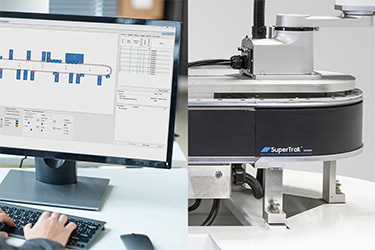
Adaptive manufacturing combines integrated building blocks into a cohesive production architecture. The goal is to design automation in a way that no longer forces trade-offs between speed, flexibility, and regulatory compliance—but optimizes them simultaneously. A key lever is how products move through production. Instead of rigid, sequential lines, systems emerge in which products can move individually, be buffered, and prioritized. Process steps are decoupled, enabling changes to be implemented in software rather than through complex mechanical modifications. This allows for significantly faster changeovers and reduces downtime, especially in environments with frequent product changes and smaller batch sizes.

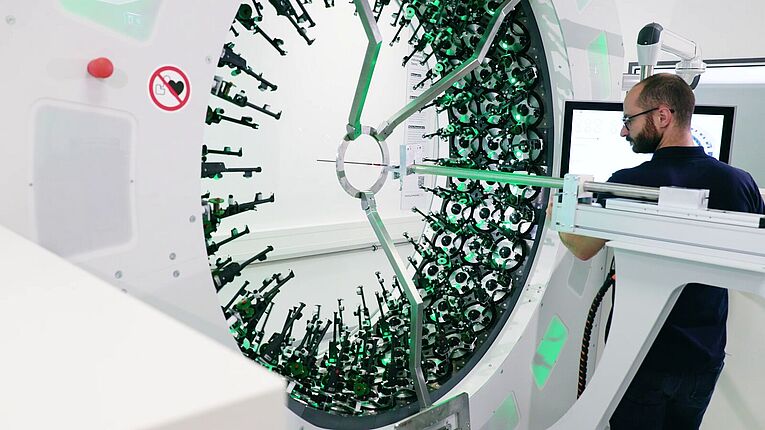
At the same time, previously separate functions such as control, motion, machine vision, and quality assurance are integrated into a unified automation architecture. This enables real-time synchronization of processes, while quality checks are performed continuously during production. Errors are detected early and can be corrected immediately—an essential advantage in pharmaceutical manufacturing, where quality management is critical to overall efficiency.

Another key component is the end-to-end use of machine simulation and digital twin technologies. Machines and processes can be developed, tested, and optimized virtually before physical implementation. Changes can be validated in advance, risks identified early, and commissioning and requalification efforts significantly reduced—from days to hours.

This flexibility is underpinned by an open and integrated data architecture. Machines, subsystems, and IT systems are connected across all levels, generating continuous data streams. These enable real-time monitoring and predictive analytics, helping to detect and prevent deviations early. At the same time, complete traceability is ensured—a core requirement for regulatory compliance and efficient release processes. Together, these elements form a new production paradigm for Europe’s pharmaceutical industry—one that fundamentally differs from traditional automation concepts. The focus is no longer on maximizing the utilization of fixed lines, but on the ability to continuously adapt to new requirements.

“For ‘Pharma made in Europe’, this means managing increasing complexity while maintaining high levels of efficiency, quality, and compliance. That is where the decisive competitive advantage lies,” says Patsakas.

Europe’s competitive edge: scaling without added complexity

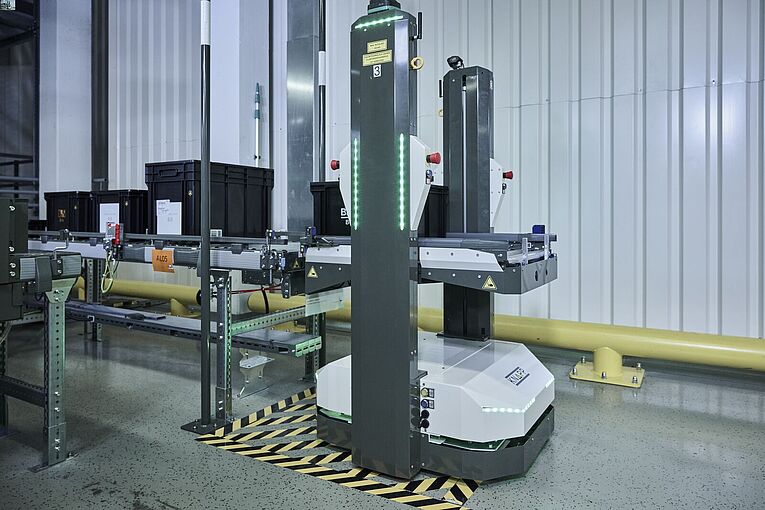
The strength of adaptive manufacturing lies less in maximizing the speed of individual processes and more in aligning production systems efficiently with changing requirements. For European pharmaceutical production, this offers a decisive advantage: instead of expanding capacity through larger facilities or additional lines, existing systems can be designed to handle more variants, smaller batch sizes, and shorter product lifecycles economically. In regulated environments and cleanrooms in particular, space efficiency is a critical factor. Mechatronic, software-driven transport systems can reduce the footprint of production setups by up to 75% in certain applications, enabling a higher process density.

“Modular structures, software-based adjustments, and end-to-end data integration allow production to respond faster to new requirements without increasing complexity to the same degree. At the same time, regulatory security is maintained because processes remain transparent and traceable,” Patsakas adds.

This shifts the competitive landscape: it is no longer the lowest production costs that determine success, but the ability to produce flexibly, in a validation-ready manner, and efficiently. This is precisely where adaptive manufacturing opens up new opportunities for Europe.

Adaptive manufacturing under real-world conditions

Practical implementation can be seen in production systems designed for maximum flexibility and traceability. In applications with frequent format changes and high quality requirements, lines must be capable of processing different products within short timeframes—without long downtimes or complex mechanical adjustments.

Adaptive production concepts rely on individually controllable product movement and software-based process logic. Changeovers are no longer performed through physical reconfiguration but via parameter adjustments, significantly reducing conversion times. At the same time, continuous data capture ensures full traceability of all process steps—an essential requirement for regulatory compliance in the pharmaceutical industry.

In development, the benefits are equally apparent: simulation and digital twins allow systems to be tested and optimized before commissioning. This reduces risks, shortens project timelines, and simplifies subsequent validation.

Adaptivity as the foundation for “Pharma made in Europe”

Reshoring pharmaceutical production to Europe requires more than expanding existing capacities. The key lies in designing production systems that can handle increasing complexity without sacrificing efficiency. Adaptive manufacturing provides the technological framework: it combines flexible production structures with end-to-end digitalization, enabling speed, quality, and compliance to be ensured simultaneously. For pharmaceutical manufacturers, this creates a new form of competitiveness. Production systems are no longer optimized for maximum output of individual products, but for the ability to continuously adapt to new requirements. That is the key to making “Pharma made in Europe” economically viable and sustainably competitive in the long term.

请选择国家和语言

B&R Logo