Seven use cases for your success
Discover how the X20-Edge transforms industrial automation. From secure connectivity and seamless IT/OT integration to flexible software deployment and future-ready architecture, X20-Edge delivers smart, scalable solutions for modern manufacturing.
Explore 7 powerful use-cases that are essential for anyone working in machine automation, each showcasing how X20-Edge from B&R drives innovation, efficiency, and future-ready solutions.


Case 1
Cyber Security & CRA in Industrial Automation
Cyber security and CRA (Cyber Resilience Act) are critical components in modern industrial automation. As systems become more connected and data-driven, protecting assets, ensuring system resilience, and enabling secure communication between devices and networks are essential for operational continuity and safety.
- Monitoring Assets, Machines, and Fleets. Implement continuous monitoring to detect anomalies, unauthorized access, and performance issues across all connected devices and systems.
- Disaster Recovery and Backup Solutions. Develop robust disaster recovery plans, including automated backup and restore mechanisms to ensure minimal downtime and data loss.
- Incident Response and Updates. Establish clear protocols for updating systems and deploying patches swiftly in the event of a security incident.
- X20-Edge as a Secure Gateway. Utilize the X20-Edge device as a secure communication bridge between operational technology and higher-level IT systems.
- PLC Visualization and Integration. Enable real-time visualization and control through PLCs, with secure data flow to higher-level systems via the X20-Edge.
- X20-Edge is a device capable of providing cybersecurity. It comes with a maintained operating system where you can run containerized IoT software and create secure connections to your machines. This is the basis for fulfilling Cyber Resilience Act.
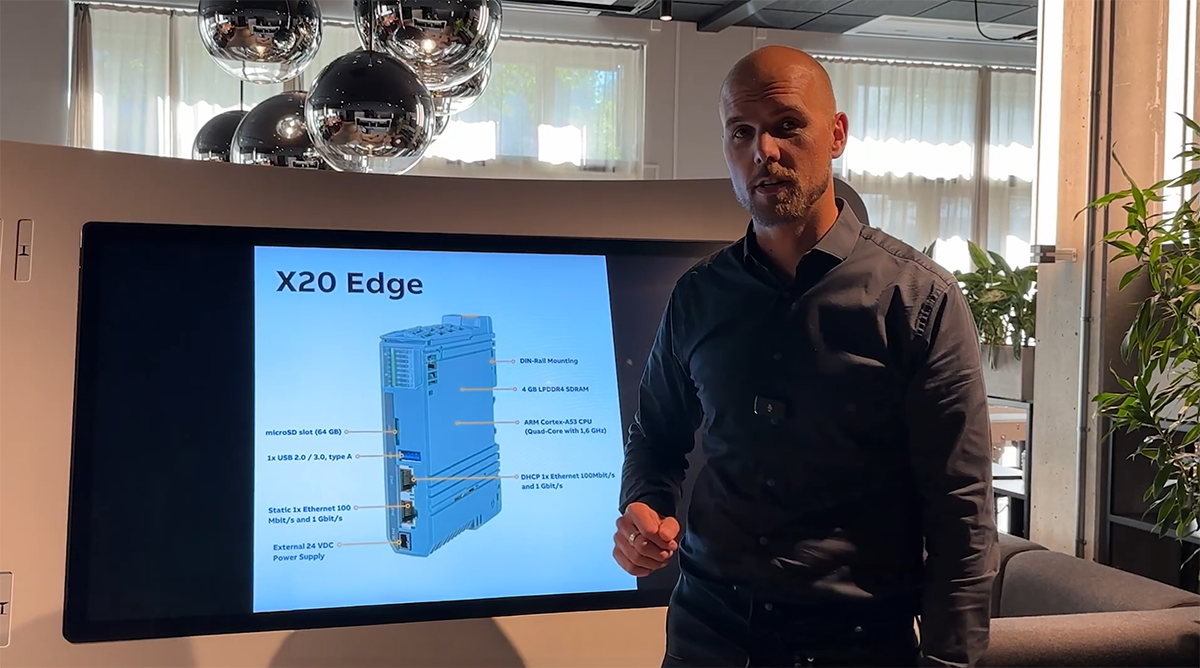

In today's industrial landscape, integrating Information Technology (IT) and Operational Technology (OT) is essential for achieving intelligent, connected, and future-ready automation systems. This summary outlines key strategies for enhancing communication between IT and OT systems.
- Reduced PLC Load. Offloading non-critical tasks from PLCs improves performance and allows focus on core automation functions.
- Protocol Flexibility. Support for diverse communication protocols ensures seamless integration and future proofing.
- Docker Plug-ins. Modular services deployed via Docker containers enable rapid innovation and simplified maintenance.
- Database Integration. Real-time data exchange with databases supports analytics, predictive maintenance, and smarter decisions.
- Future-Ready Architecture. Scalable and adaptable systems designed to accommodate emerging technologies and business needs.
- Bridging IT and OT. Unified ecosystem promotes transparency, efficiency, and data-driven operations across the enterprise.

Effective software deployment is critical in industrial environments where stability, control, and scalabilities are essential. A well-defined deployment strategy ensures reliable operations, support large-scale installations and integrate seamlessly with modern development workflows.
- Strategic Deployment Planning. Establishing a robust strategy for software deployment ensures consistency, minimizes downtime, and supports long-term scalability.
- Device-Specific Capabilities. Certain devices are uniquely equipped to handle deployment tasks, providing specialized functionality and reliability.
- Fleet-Wide Control. Deployment processes are designed to manage software across large fleets, ensuring uniform updates and centralized control.
- Unlimited Deployment Flexibility. Systems support unlimited software deployments, enabling continuous improvement and rapid iteration.
- Integration with DevOps. Deployment is part of the DevOps lifecycle, including code base testing and CI/CD pipelines for automated and efficient delivery.

OEMs must prepare for future requirements by building flexible and scalable platforms. This includes anticipating customer needs, enabling feature expansion, and supporting new machine types. Here are key areas where OEMs can create long-term value:
- Anticipating Future Needs. OEMs should consider what customers may require in the future, even if those needs are not currently on the radar.
- Planning for Later Implementation. Design systems with the ability to integrate new features or technologies later without major redesigns.
- Extensible Machine Platforms. Create platforms that allow for easy expansion of machine capabilities, supporting modular upgrades and feature additions.

The X20-Edge platform offers a flexible and secure environment for software development and testing. Instead of relying on traditional PLCs or machine controllers, developers can use X20-Edge as a sandbox playground to experiment, deploy, and validate new solutions with minimal risk to production systems.
- Docker Integration. X20-Edge supports Docker containers, enabling modular and scalable deployment of open-source applications.
- Open-Source Flexibility. Developers can leverage open-source tools and libraries to accelerate innovation and reduce development costs.
- Sandbox Environment. The playground setup isolates development activities from live operations, ensuring safety and control.

Enables seamless integration of external devices and hardware components. It simplifies system expansion, enhances flexibility, and supports rapid deployment of new technologies without complex configuration.
- Easy USB Integration. Industrial systems can easily incorporate USB devices, allowing quick expansion and connectivity.
- Broad Hardware Compatibility. Supports plug-in of various communication and equipment types including Bluetooth modules, USB sticks, and web cameras.
- Rapid Deployment and Flexibility. Plug & Play design allows fast setup and reconfiguration, reducing downtime and increasing adaptability.

The X20-Edge platform offers a flexible and secure environment for software development and testing. Instead of relying on traditional PLCs or machine controllers, developers can use X20-Edge as a sandbox playground to experiment, deploy, and validate new solutions with minimal risk to production systems.
- Contextual Positioning. X20-Edge is positioned alongside B&R APCs, serving as the entry-level solution for industrial edge computing.
- Scalable Architecture. It can be scaled up using the broader B&R APC and APC-mobile portfolio, allowing for seamless expansion and performance upgrades that fit the unique installation requirements.
- Industrial Reliability. X20-Edge is a finalized and robust industrial product, designed for dependable operation in demanding environments.
- Lifecycle Integration. As part of the B&R lifecycle process, X20-Edge ensures compatibility, support, and long-term sustainability.
Find out how to improve the efficiency, precision and flexibility of your machines and systems.
Get valuable insights into trends, technologies, and innovations from the world of industrial automation.
Analytics anywhere
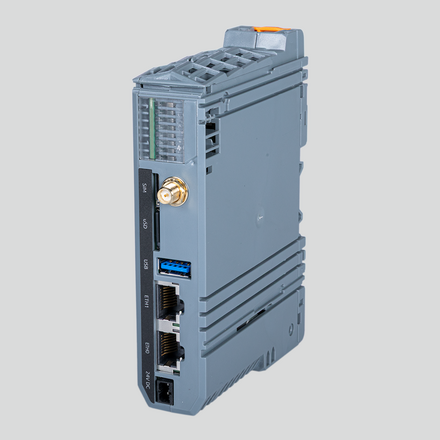
X20 Edge with built-in 4G modem
A new variant of the B&R X20 Edge features an integrated 4G modem. This opens up vast new possibilities and use cases for connecting machine control to enterprise systems in remote locations without local network infrastructure, along with additional flexibility and data logging capabilities leveraging the Industrial IoT.