Up to 20% more throughput
In high-performance robotic applications, vibration is one of the most common – and costly – limiting factors. As robots become faster and lighter, unwanted oscillations increasingly restrict achievable speed, accuracy, and throughput.
Vibrations typically occur during rapid acceleration, deceleration, or direction changes. Even small oscillations at the end of a movement can force machines to pause before continuing, reducing overall throughput. In high-speed applications such as packaging or pick-and-place, these effects quickly add up and become a significant productivity bottleneck.
Traditionally, engineers had little choice but to slow down motion, add settling times, or invest in mechanical overdesign to maintain stability. Today, this trade-off is no longer necessary.
With software-based Vibration Control integrated into the B&R mapp Robotics environment, robot motion can be stabilized automatically and in real time. Instead of limiting dynamics, the control system actively compensates for mechanical flexibilities during movement, enabling faster and more precise robot operation purely software based.
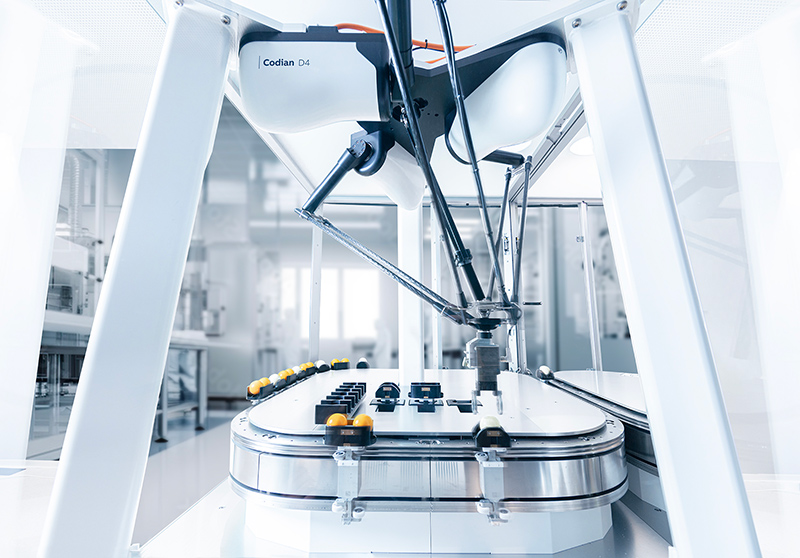
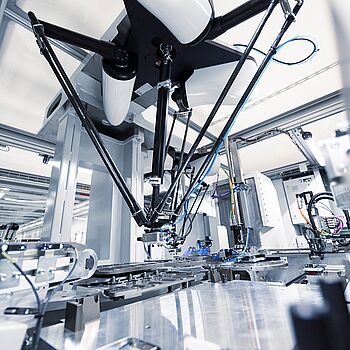
Integrated vibration damping addresses this challenge directly. By using model-based control algorithms optimized for robotic motion, oscillations are suppressed during movement. The result is smoother motion, immediate stability at the target position, and consistent accuracy even at high speeds. Because the functionality is natively integrated into the Machine-Centric Robotics (MCR) system, it combines motion, robot, and control into one optimized solution. Advanced model-based algorithms are applied automatically, making high-end performance accessible without requiring expert knowledge.
A typical use case is a high-speed delta robot on a packaging line. Without vibration control, oscillations at maximum speed often force brief waiting times between cycles. With active vibration damping, these oscillations are eliminated on the fly, allowing the robot to move faster from pick to place while maintaining precise positioning. In practical terms, this can increase picking rates by around 10 – 20 %, without mechanical modifications or loss of accuracy.
For machine builders and operators, the benefits are tangible. Robots can run faster while maintaining accuracy, directly increasing output. Engineering effort is reduced because time-consuming manual tuning is no longer required. At the same time, smoother motion lowers mechanical stress, supporting longer machine lifetime and higher availability.
Vibration Control allows faster, more precise, and more stable robot motion – automatically and without engineering effort.

As a core capability of the Machine-Centric Robotics architecture, this approach is scalable across different robot types and applications, turning vibration control into a standard software feature rather than a specialized engineering task. This enables manufacturers to push robot performance further – efficiently, reliably, and with less effort. Reducing robot oscillation no longer means slowing machines down. Intelligent vibration control makes high-speed, stable robot motion a practical reality.